We Couldn’t Buy It. So We Built It.
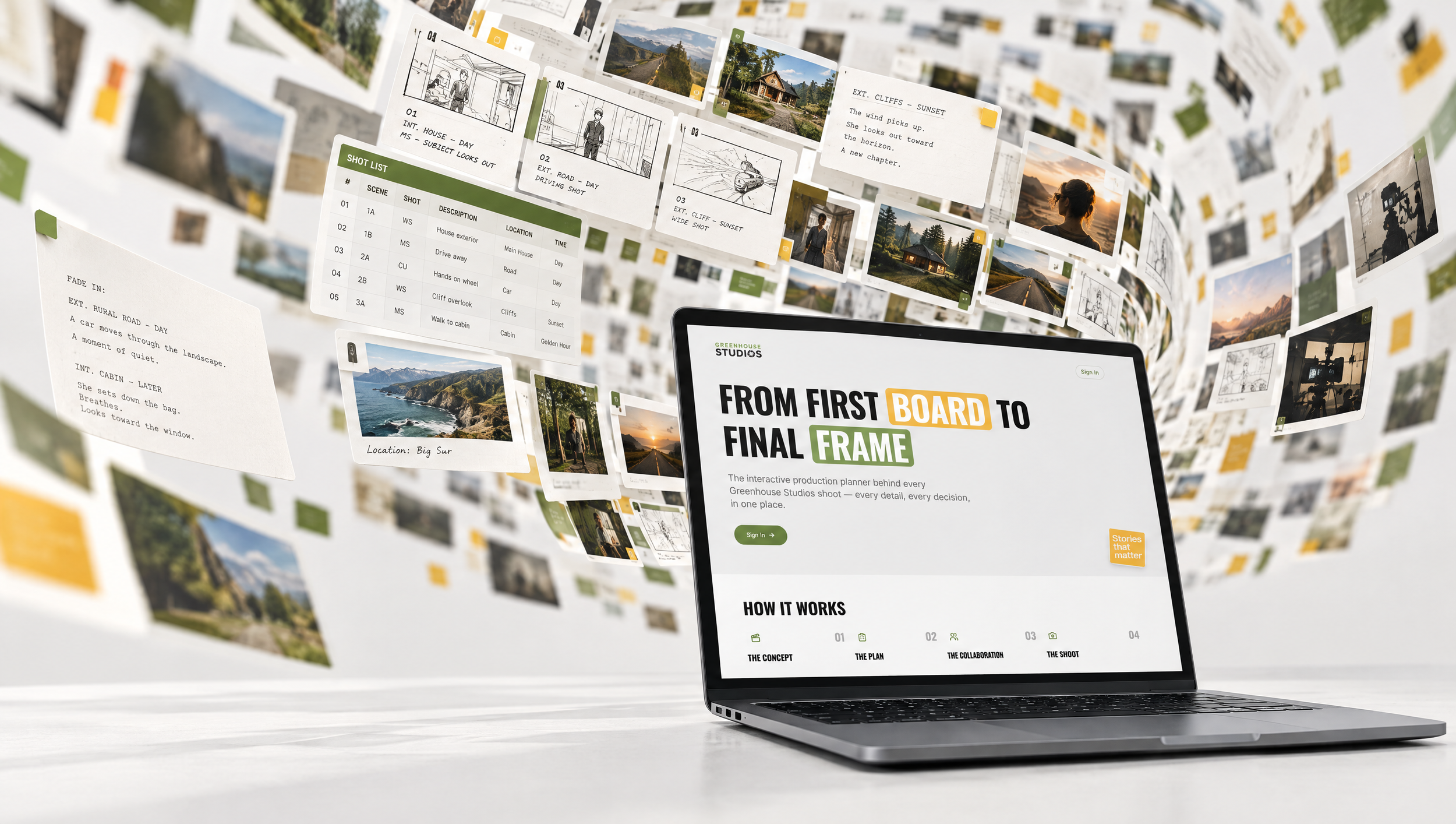
A complex shoot, a twenty-minute brainstorm, and what happens when the people who know the work start building the tools.
Key Takeaways
A production needs one brain, not a dozen documents: Our system for managing productions worked, but the information lived across separate tools. We wanted one connected dashboard where everything updates together.
Off-the-shelf software covers pieces, not your process: Team-grade production platforms cost thousands a year and are built around someone else's workflow. We needed one built around ours.
Expertise made the software right: AI built our production planner app in three days. Years of knowing what makes a production succeed made it the right app.
Everything connects: Storyboards become scripts, scripts tag to talent, talent get call sheets. Edit a scene and the change flows through the whole system.
The platform matters: Synthetiq handled accounts, roles, permissions and client access, which let an internal tool become something clients work inside.
Welcome to the long tail of tools: Teams with the right expertise can now build software that fits them exactly, and change it the same day a need appears, instead of waiting on a vendor's roadmap.
A Feature That Didn't Exist Five Minutes Earlier
It was the Thursday before a four-day shoot in Texas, and we were generating call sheets.
Call sheets are what keep producers up at night. Get one detail wrong and an actor shows up at the wrong time, or the wrong house, or ready to deliver the wrong lines. With 15 actors across three commercials, a sleepless night was the least of our concerns.
This time, every detail lived in an app I'd built a few weeks earlier on Synthetiq, an AI platform that turns plain-English descriptions into working business software. Schedule, locations, talent, props, approved storyboards, shot list: one place, with AI underneath to generate the documents a production runs on.
So every actor needed a call time, a location, wardrobe notes, and their lines. The lines existed. They were written right there in the storyboard frames, voiceover and dialogue mixed together, the way boards always are.
Our video producer looked up. "Can this thing pull each person's dialogue onto their call sheet?"
What he was really asking was whether the app could read the boards and pull out the script. Then separate voiceover from on-camera dialogue, match each line to a role, and put the right lines on the right sheet for the right actor. No errors.
It couldn't. But I said, "Hold on. It can."
I opened Synthetiq and typed a prompt. A few minutes later, the app did all of it.
That exchange happened over and over in the weeks before the shoot. Some days we shipped three new versions. It's how a Chief Content Officer without an engineering background ended up shipping software.
My job at Greenhouse Studios is to make sure brand strategy turns into storytelling that actually moves people. But the hardest problem on a production isn't always creative. Often it's logistics and information: dozens of moving parts, many contributors, every decision depending on three others. This fall, with a complicated shoot bearing down, we built a tool to handle that. In three days. This is how, why it worked, and what it says about where software in the creative industry is headed.
One Brain, Not a Dozen Documents
On September 9, less than a month out, I sat down with our producer to work through the shoot. Three commercials, each one a continuous take (a "oner," for fans of The Studio) flown by an FPV drone, with a second drone and a ground camera in support. Fifteen on-screen talent, twenty more people on set, three locations over four days, a drone operator flying in from California. Every line and every bit of action timed to a flight path that couldn't be fixed in post.
The list of moving parts kept growing. Casting across three spots. Location walkthroughs. Props by scene. Who owns what, and when.
We've run productions like this for years, and we have a system that works. Every shoot builds toward the production book: schedule, team, locations, talent, boards and shot list in one document. The crew works from it. The client approves from it.
But a system that works isn't the same as a system that's smart. Behind the book sat a dozen documents, each one right, none of them connected. Change one thing and somebody has to remember everywhere else it matters.
What I wanted was one brain behind the production. A single dashboard where everything lives and updates together, flags what's falling behind, and shows who's on it. A place to run casting reviews and shot planning together, not just document them afterward.
There's good production software out there, and we could have bought some of it. The most capable platforms run $300 to $400 a month for team plans, so call it $3,000 to $5,000 a year. They're well made. But they're built around a screenplay and a film crew, not an agency's approved boards, a statement of work and a client who needs to approve talent. We'd be paying to bend our process to fit someone else's.
Hold On. It Can.
Not long ago, building our own would have meant a six-month project, a team of developers and tens of thousands of dollars. That's not how things work anymore.
A few weeks earlier I'd built our first tool on Synthetiq, a social content studio that keeps every client's brand voice in one always-current place. Talking through the shoot, it clicked. Same shape of problem: lots of contributors, scattered information, one connected home needed. And if the platform could handle who sees what, the client could be in it too.
So we hit record. A twenty-minute brainstorm became a transcript. Claude turned the transcript into a brief. I gave Synthetiq the brief and one prompt. Part of it:
"Take our existing process and the production book we put together for each shoot and turn it into an interactive planning tool – a master dashboard that shows the status of every aspect of pre-production and flags where critical path items are at risk, a simpler client area, and tabs for project summary, team, equipment, talent and wardrobe, locations, run of show, approved boards, and a shot-by-shot list with notes about how we plan to capture each shot."
The first pass was impressive. I refined it here and there between other work, and by Friday afternoon the team was logged in. It worked because the prompt wasn't really about software. It was about production: what a good shoot needs, where things break, what a producer reaches for at 6am on set. AI built the app. The expertise made it the right app.
Then the team started using it, and it started changing. Someone wanted to drag a location from "under consideration" into a scene. Someone wanted the shot list sorted by filming order. Someone wanted printable to-do lists generated automatically.
What emerged is a system where every piece talks to the others. The storyboards are the source. Upload them and the app scans each page, detects the frames and turns them into a shot list. It reads the same boards for the script, separates voiceover from dialogue and tags every line to a role. Cast talent into the roles and the call sheets build themselves.
Now change a scene in the storyboard. The change flows to the shot list, the script, the role and the call sheet. One edit instead of five documents updated by hand. The same idea runs everywhere: paste in an Airbnb listing and the location builds itself, photos and all. Record a planning conversation and the app drafts the run of show.
The Unglamorous Parts
A fair question at this point: how is someone who isn't an engineer doing this?
Most of the answer is the platform. Plenty of tools now turn a description into an app, but most are built for prototypes. We needed something twenty people could log into, that a client could see part of but not all of, and that wouldn't fall over halfway through a production.
That's the gap Synthetiq is built for. Prototyping tools are fast but stop short of real business use. Enterprise platforms are solid but slow, expensive and need a technical team. Synthetiq sits between them, and the difference is in the unglamorous parts: accounts, roles, who's allowed to see what.
That plumbing is why "hold on, it can" was a reasonable thing to say. It's also why the planner does more than save us time. The client logs into a simpler area to review talent and locations and approve selects, while internal timelines, critical paths and budgets stay private. An efficiency tool became something clients experience.
The Long Tail of Tools
By the time we landed in Texas, props were assigned by scene with owners attached. Call sheets had gone out in one pass, each actor's lines on their own sheet. Costs were logged receipt by receipt, between setups. And on day one, our producer handed the client the production book: exported from the app, printed, bound. The most analog object on set, generated by software we built ourselves.
The day or two of assembling that book disappeared, but the time didn't vanish. It moved earlier, into planning and creative decisions, where you want it. The team still chose every shot. The hard part was never the building. It was knowing our own process well enough to describe it. That knowledge took years. The software took days.
Earlier this year we wrote about the creative industry's long tail: as production costs collapse, small, specialized studios with a real point of view can thrive. The same thing is happening to software. For two decades, building your own tools was slow and expensive, so you bought what existed and adapted to it. If you needed something niche, you filed a feature request and waited. Months, sometimes years. A commercial agency's call-sheet workflow was never going to top anyone's roadmap.
That deal is breaking down. In Retool's 2026 Build vs. Buy report, 35% of teams had already replaced at least one piece of software with something they built themselves, and 78% planned to build more this year. This month, a developer released AI-built alternatives to Photoshop, Premiere, Acrobat and InDesign. Rough around the edges, but they exist.
Big software doesn't disappear. What's emerging alongside it is a long tail of tools: thousands of small, purpose-built apps, each made by the people who use them, fitted exactly to how they work, and changed the same day a need shows up. Not a roadmap. A conversation in a meeting, and five minutes later, the feature.
That's what we're building toward. The planner is one piece. The social studio is another. Three working apps in September alone, each built from what we know about brand strategy and storytelling, each one putting clients inside the work instead of waiting on it. Personal software: our workflow, not a vendor's approximation of it.
None of it replaces the craft. All of it was built from it.
Two people who know production cold said out loud what they needed. By Friday, it existed.
Greenhouse Studios is the content studio within Greenhouse Partners, an award-winning brand strategy and advertising firm based in Boulder, Colorado. We help brands tell stories that matter, with whatever tools make sense for the work.
FAQs
Can you build a real business app without knowing how to code?
Yes, if the platform handles the parts that make an app safe to put in front of a team or a client: user accounts, roles, permissions and who can see what. Most vibe-coding tools are built for prototypes and stop short of that. Enterprise-grade platforms like Synthetiq include it, which is how a Chief Content Officer with no engineering background shipped a multi-user production planning app in three days that both his team and his client log into.
Should companies build their own software instead of buying SaaS?
Increasingly, for specific workflows, yes. In Retool’s 2026 Build vs. Buy report, 35% of teams had already replaced at least one SaaS tool with something custom-built and 78% planned to build more this year. Off-the-shelf software fits a generic workflow; custom tools fit yours. The best candidates are niche internal processes no vendor will ever prioritize, which is exactly where a commercial agency’s production planning sits.
How is AI changing video production workflows?
Beyond generating footage, AI is reshaping the logistics behind a shoot. It can read storyboards and extract shot lists and scripts, generate call sheets with each actor’s lines, draft a run of show from a recorded planning conversation, pull location details from a listing, and track budget against receipts. The creative decisions still belong to people. What changes is how much of the connective work between those decisions gets handled automatically.
What is the best production management software for agencies?
The leading platforms, including StudioBinder, Yamdu, Filmustage and Celtx, cover shot lists, storyboards, scheduling and call sheets, with team plans running roughly $300 to $400 a month. Most are built around scripted film and TV workflows: a screenplay and a crew. Agencies running commercial productions from approved boards, a statement of work and client approvals often find the fit imperfect, which is why some are now building their own.
Will AI replace creative agencies?
Not the ones with real expertise. AI lowers the cost of production and of building tools, which makes it easier for anyone to produce something. But knowing what a good shoot needs, where a production breaks and what a brand should say still takes years of experience. In Greenhouse Studios’ case, the hard part of building its planner wasn’t the software. It was knowing the process well enough to describe it. That knowledge is the moat.
What is Synthetiq?
Synthetiq is an enterprise AI platform that lets business users build working, multi-user applications by describing them in plain English. Apps connect to the company’s own data and include user accounts, roles, permissions and client access by default. Greenhouse Studios, the content studio within Boulder-based Greenhouse Partners, used it to build its Production Planner and Greenhouse Social Studio. See the studio’s work here.